
Rice on Nan : The Sacred Lines You Do Not Cross
By Sunil Nair, Resident South Indian Rice Purist
There’s something sacred about food. Something filthy, too. Food is culture, memory, identity—but it’s also rebellion, bad decisions, midnight cravings. And it’s only in those moments of bad decision that we really see who we are.
I saw who I was the night a bloke — normally decent, funny, no harm done — placed rice on top of naan. I watched him load a fistful of fluffy basmati, scoop it like a shovel, and dump it upon warm naan. I froze. My brain short-circuited like a Windows XP laptop trying to open 15 Chrome tabs. My heart sank, my throat dried out, and I could almost hear the ghost of every Indian grandmother collectively clutching their rolling pins in horror.
I didn’t know whether to stop him, call out “No!” like a cornered man, or just leave.
Because Naan Is Not a Plate
I’m a South Indian. Rice runs in our veins. I ate rice for breakfast, lunch and dinner as a kid. We treat it with reverence. It’s the foundation of our meals, the rhythm of our culinary heartbeat. Naan, on the other hand, is a proud North Indian creation — a wheat-based companion meant for scooping up gravies, not serving as a base layer for other carbs.
Rice is delicate. It’s forgiving. It bows under gravy and absorbs the spice, the sweat, the heat. Naan is proud. Charred in spots. Crisp edges giving way to chewy folds. Its job: to be a conveyance for sauces, curries, chutneys — not a base for other starches.
When you put rice on naan, you are violating roles, norms, boundaries and borders. It's not like the British empire didn't do that enough already.
You’re asking naan to play plate. You’re making rice carry naan’s burden. Rice on naan is like putting a sandwich inside another sandwich. It’s the edible equivalent of wearing socks over your shoes. It’s not just wrong — it’s structurally confusing.
Of Taste, Memory, Identity
When I eat rice, I remember lunchtime under a sweltering ceiling fan, sweating with mango slices in my hand, sambhar smell in my hand hours after i ate lunch, curry leaves on the floor. When I eat naan, I think of hot sizzling tandoors, late nights at roadside Dhaba, smoky air, garlic breath, with the classic “ting ting ting” Indian music in the background. Each evokes place, memories and identities. Each is its own language.
Putting rice on naan flattens the dialects. It’s admiring Mona Lisa with your eyes closed after standing for hours in the queue. It’s taking John Keats poetry, folding it, using it as an ass wipe.
Indian food isn’t about excess. It’s about balance — spice, texture, heat, and depth. Each element serves a purpose. The curry moistens the rice; the naan scoops the curry. One’s soft, one’s firm. One absorbs, the other delivers.
Rice on naan destroys that order. It’s chaos masquerading as creativity. Gandhi wouldn’t approve. Neither would Gordon Ramsay. Rice on naan is like putting a sandwich inside another sandwich. It’s the edible equivalent of wearing socks over your shoes. It’s not just wrong — it’s structurally confusing.
The Empires Equivalents
Since my British and Aussie teammates insist on defending this act as “just carbs, mate,” let’s put this in relatable terms. Let’s translate this transgression into the idioms of your own kitchens. If you want to feel the same disgust I feel, imagine…
Pouring baked beans on top of a Yorkshire pudding and calling it fusion.
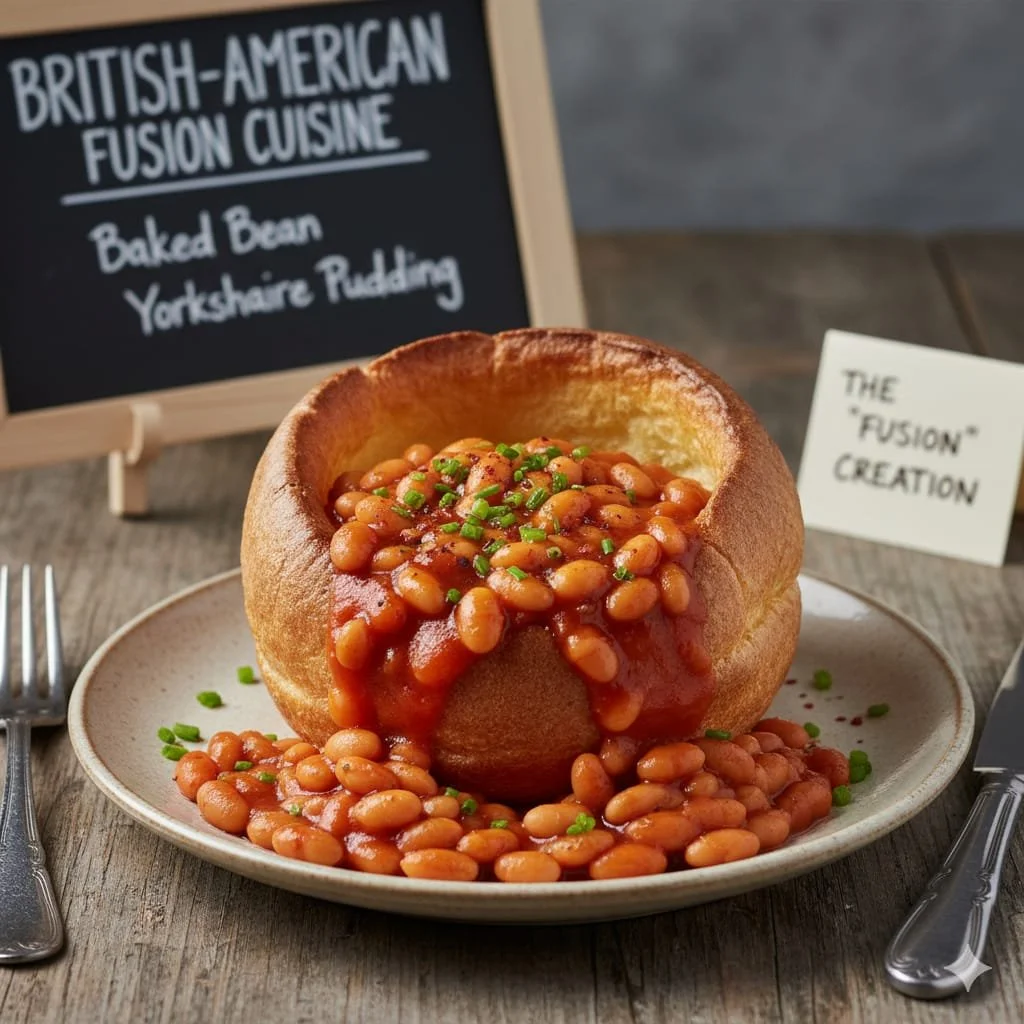
Fusion or confusion.
Spreading Vegemite and Marmite on the same toast — the gastronomic equivalent of declaring war on your own taste buds.
Dunking a freshly baked sausage roll in your cold tea with milk.
Pouring irish stew into Yorkshire pudding and wrapping shepherd’s pie in scone — chaos without meaning.
Using croutons as dipping sticks for mashed potatoes
It’s not picky. It’s respect—for what the food is, what it wants to be, what it deserves.

Inspired or expiring.
Forgive, But Never Forget
I love Indian food in all its riot: green chiles, tamarinds, sugars, incense, butter, coconut, pepper. But even riot has order. You let rice be rice. Let naan be naan. Give each its moment. A curry is not just flavor; it’s glue that binds them together.
Indian cuisine, for all its chaos, has rules — ancient, unspoken, but deeply intuitive. You don’t mix two primary starches unless you’re trying to summon the wrath of your ancestors. It’s a sacred balance: rice goes with curries, naan goes with gravies, idli goes with chutney, dosa goes with sambar. There’s logic in that madness — textural harmony, contrast, temperature, mouthfeel.
Eating rice on naan does not just confuse textures. It blurs cultural geography. It blurs responsibility. Putting rice on naan ruins all of that.
It’s like blowing “God Save the King” on a didgeridoo.
On Being Humble with Our Hunger
Now, to be fair, we all make culinary mistakes. I’ve seen Brits microwave samosas. Aussies drown butter chicken in ketchup. Somewhere out there, an American is preparing butter chicken on top of Nachos and calling it “Naan-Chos.”
So, I’m not angry. Just… disappointed.
If we respect what food asks of us, we respect people: the makers, the history, the hungry and the unfed. We are all better for it. When I travel, I bow to these rules. When I cook, I try to honor them. Even when I rage—and I do rage at rice-on-naan—I try to remember something else: that we are, always, creatures of hope, taste, laughter.
The next time you’re tempted to pile rice on naan, pause for a moment. Think of the centuries of culture, the recipes passed down through grandmothers who could season a curry blindfolded. Think of the thousands of Indians who’d collectively gasp in horror — not out of snobbery, but out of love.
Club Policy on Rice–Naan Relations (Revised & Fortified)
Article I. Any club member who commits the sin of rice-on-naan shall immediately serve as the Official Naan-Holder at the next dinner, eating nothing but naan for the full meal.
Article II. Offenders are to endure a “Tour of Taste Contrition”: first, blind-taste test of rice vs naan vs rice on naan; second, write a 500-word reflection on what it felt like; third, publicly declare at the bar “I repent, I will not shame naan again.”
Article III. No dish may carry two primary starches unless explicitly declared and documented. Examples: chips with mash; bread stuffed with bread; pie crust under cake. These require Prior Approval from the crust/crumb committee (that is: me).
Article IV. Culinary creativity is encouraged — but not at the cost of principle. Take risks. Fuse flavors. But do not fuse roles. Do not force naan into being a plate. Do not force rice into garnish for your naan.
Article V. The Great Naan Incident shall be memorialized. We will talk about it often. Not to shame the offenders but to not forget our past and sins.